Creating and Maintaining Your Last Will and Testament
About two-thirds of American adults don't have a will. Not because they don't care what happens to their family — because it's the kind of task that stays on the list for years. If you're reading this, you're already past the hard part.
There are two ways to handle a will here, and you should pick before you start:
- You don't have one yet — use the guided wizard, built to your state's requirements.
- You already have one — your attorney drew it up, or you made one years ago. Add it here and record the details, so your family can actually find it.
Either way, the will ends up as a record in Legal › Last will, encrypted with your own keys, assigned to whichever vaults should carry it.
Step 1: Open the Legal section
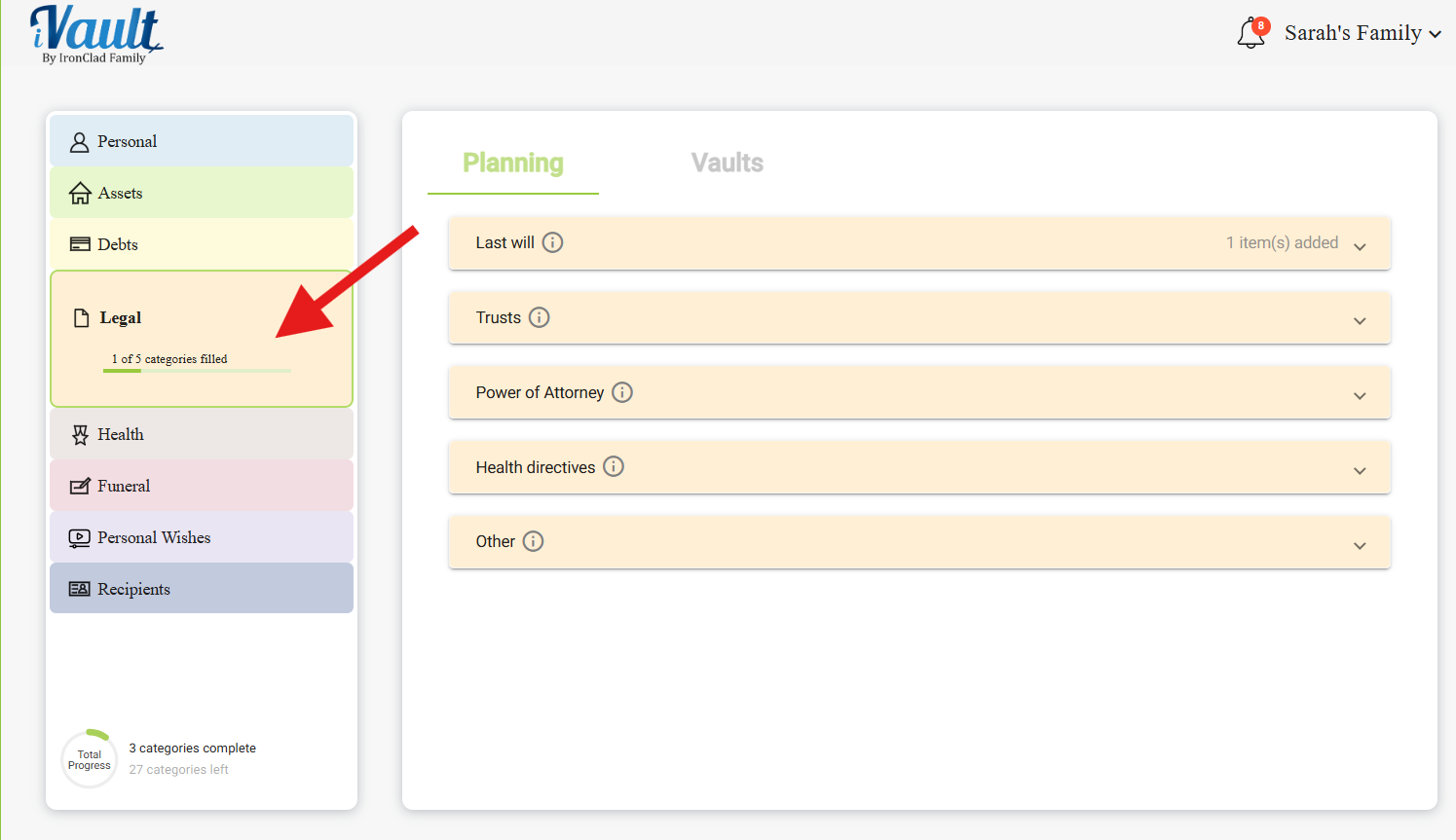
Click Legal in the left-hand navigation, then open Last will.
Step 2: Choose your path
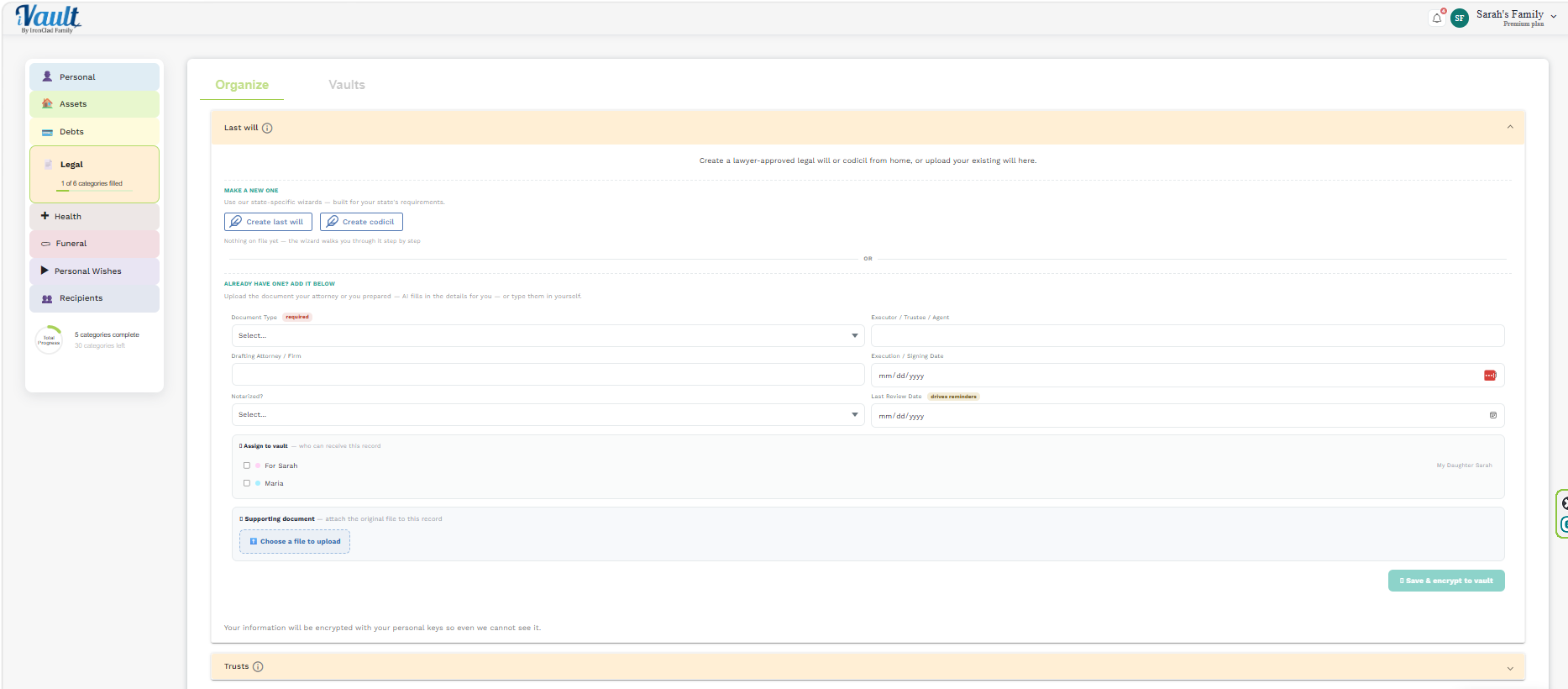
Open Last will and you'll see the choice laid out: a section headed MAKE A NEW ONE with buttons for Create last will and Create codicil, then an OR, then ALREADY HAVE ONE? ADD IT BELOW with the form for recording a will you already have.
Both wizards launch from this same screen — a codicil is an amendment to an existing will, so it lives alongside it rather than in its own section.
The panel also tells you where you stand — either “Nothing on file yet” or a count of what's already recorded. If you've been meaning to do this for a while, that line is the honest answer.
Step 3 (Option A): Build a will with the wizard
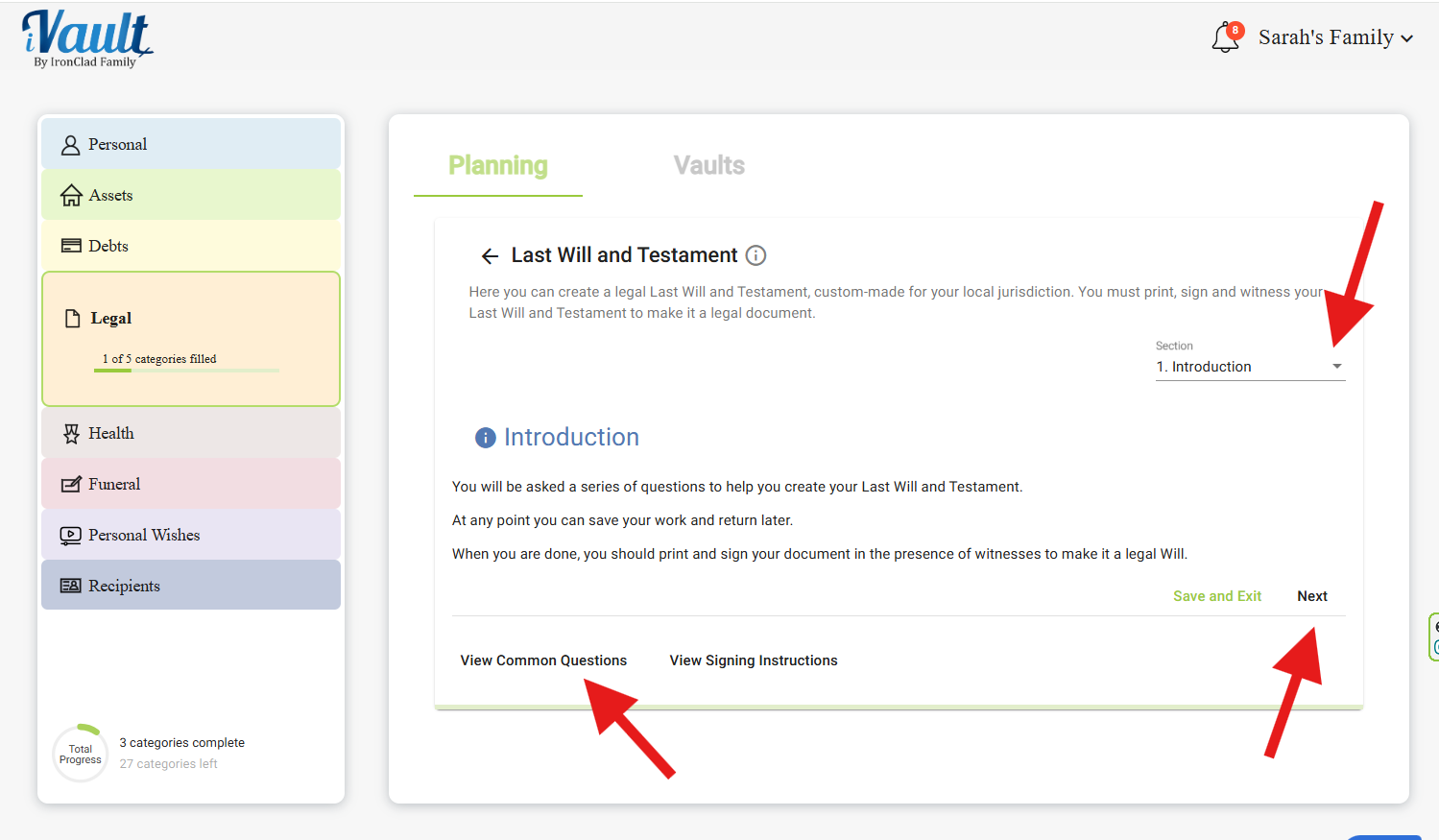
Click Create last will to launch the guided questionnaire. Inside the builder you can:
- Use Next and Back to move between steps
- Jump between sections using the dropdown navigation
- Review Common Questions and Signing Instructions as you go
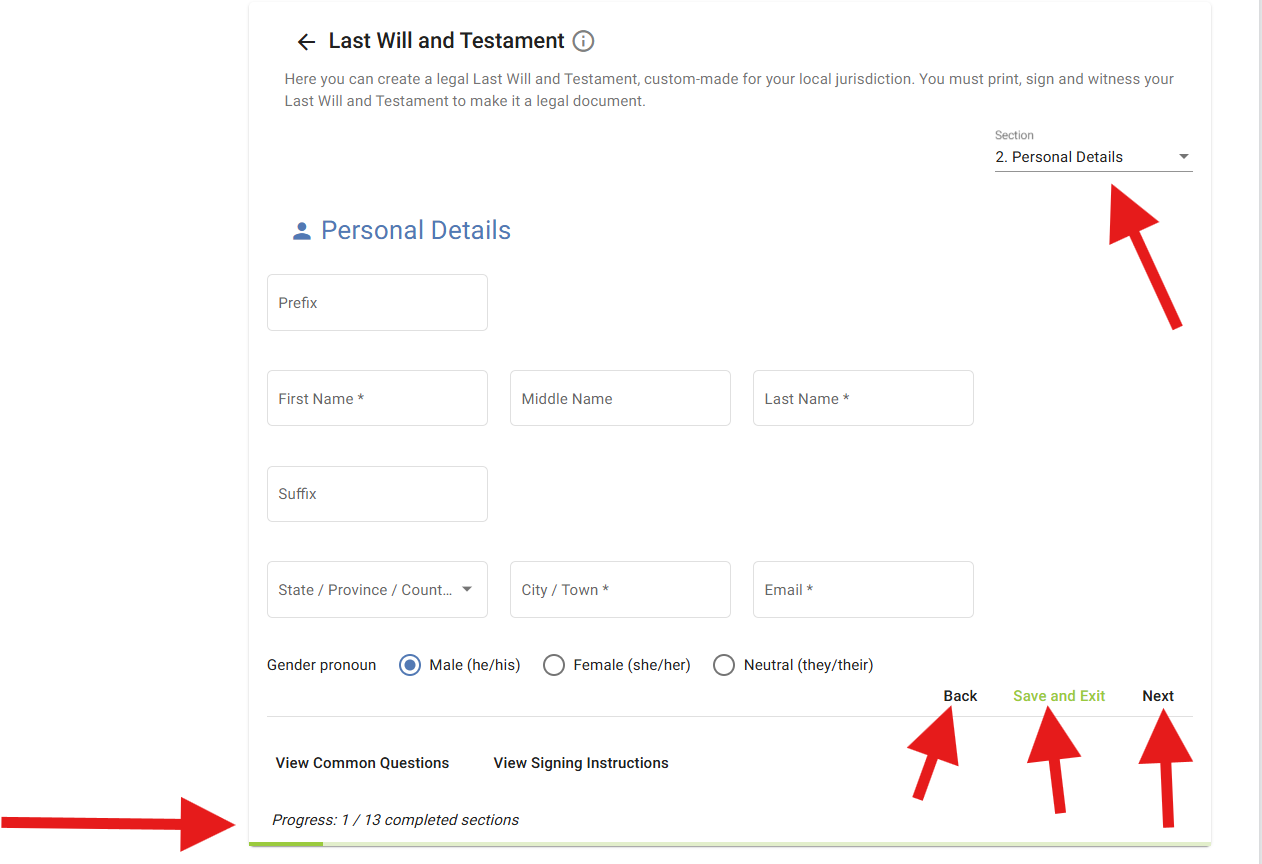
Save your progress as you go, and use Save and Exit whenever you need to stop. You'll pick up where you left off.
Expect to hit a question you can't answer right away — usually the guardian for your children, or who should serve as executor. That's normal, and it's worth stopping to have the conversation rather than guessing. Save and exit, talk to the person you're thinking of naming, come back.
When you finish all required sections you'll return to the main Last Will menu with a confirmation that your will has been created.
Will-signing rules vary by state and country. Many jurisdictions require:
- Two adult witnesses who are not beneficiaries, and
- In some cases, notarization or additional forms for “self-proving” wills.
If your state requires a physical signed copy:
- Download the completed will
- Print and sign it following your local rules
- Have witnesses and a notary sign, if required
- Attach the fully executed copy back to your will record — so the signed version is the one your family receives
That last step is the one people skip, and it's the one that counts. An unsigned draft in your vault isn't a will. Get it witnessed, scan it, attach it.
Step 3 (Option B): Record a will you already have
Scroll past the wizard buttons to the form below. This is where you record the details of an existing will — and it's worth doing carefully, because these fields are what your family reads when they don't yet have the document open.
What the form asks for
- Document Type (required) — will, codicil, revocable trust, irrevocable trust, financial POA, medical POA, advance directive, or guardianship. One record per document. If you have a will and a trust and a healthcare directive, that's three records, each in its right subcategory.
- Executor / Trustee / Agent — the person who will actually carry this out. Name them exactly as they appear in the document, and make sure that person is also set up as a recipient on the vault this record goes into.
- Drafting Attorney / Firm — who prepared it. Your family will want to call them, and this saves an hour of searching old email.
- Execution / Signing Date — when it was signed. If that date is more than a few years old, treat it as a prompt: has anything changed since?
- Notarized? — yes, no, or not sure. “Not sure” is a perfectly honest answer and a reason to check.
- Last Review Date — tagged drives reminders. Fill this in and your will comes back around in your weekly digest, so a will written before your second child doesn't quietly stay that way.
Then tick the vaults that should carry it, attach the document under Supporting document › Choose a file to upload, and click Save & encrypt to vault.
Step 4: Assign your will to vaults
Above the document upload is the vault picker — Assign to vault — who can receive this record — listing each vault with its color dot and the recipients attached to it, so you can see who you're actually sending this to. Tick every vault that should carry it. Most people assign a will to at least two:
- The family vault, so your spouse and adult children have it
- An estate or attorney vault, so your executor and attorney get it directly
Confirm each of those vaults has the right recipients and the right delivery condition — usually death or incapacitation. When the condition is met, the will is delivered.
Keeping it current
A will isn't a one-time task. It's a document that quietly goes out of date while your life changes around it. Revisit it after:
- A marriage, divorce, or remarriage
- A birth or adoption
- A death — particularly of anyone you named as executor, guardian, or beneficiary
- A move to another state
- Buying property, selling a business, or a significant change in what you own
When the will is updated, don't create a second record. Open the existing one, use the ⋮ menu › Edit details, update the execution date, and use Replace on the attached document to swap in the new signed version.
One record, always current. Two wills in a vault with no clear indication of which is live is exactly the confusion you're trying to spare your family.
Related Articles
Was this article helpful?
That’s Great!
Thank you for your feedback
Sorry! We couldn't be helpful
Thank you for your feedback
Feedback sent
We appreciate your effort and will try to fix the article