Advisor Compliance Features Overview
iVaultX reduces compliance friction by making client-document work trackable, consistent, and easy to evidence. It gives you a structured, time-stamped record of the work you did, the documents you relied on, and the steps taken to close client gaps.
What this is (and isn't): iVaultX supports your firm's compliance program by improving documentation and audit readiness. It does not replace your firm's policies, supervision, archiving rules, or regulatory obligations.
Why this matters
- Defensible client work: when questions come up later, you can show what happened and when.
- Reduced ambiguity: better history and consistency across clients cuts down on “he said / she said.”
- Audit readiness: retrieve supporting documentation and activity history quickly when asked.
- Standardization: a consistent structure makes it easier to supervise, review, and spot gaps.
1) Structured records, not just stored files
This is the most significant compliance improvement in the current platform, and it's worth understanding properly.
Client information is now held as records — structured fields describing an account, policy, ID, or legal document — with the source document attached alongside. A stored PDF tells a reviewer nothing without opening it. A record shows carrier, policy number, coverage amount, and named beneficiary on the screen.
For documentation purposes, that means:
- Reviewable at a glance. A supervisor can assess coverage across a book of clients without opening individual documents.
- Gaps are visible as gaps. An empty required field is evidence of a known outstanding item, not an oversight nobody noticed.
- Consistent capture across advisors. The same form asks the same questions regardless of who's sitting with the client.
2) Beneficiary designations as documented gap-closure
Financial, life insurance, and crypto records each capture the beneficiary the institution has on file — the payable-on-death or transfer-on-death designation that legally overrides the client's will.
This is worth calling out separately because it's one of the clearest examples of documented advisory value in the platform. A stale designation naming an ex-spouse or a deceased parent is a live problem in most books of business, and it is rarely discovered until it's too late to fix.
Recording the designation creates a dated record of what you found, what you flagged, and what the client chose to do about it. That's a defensible file — and a conversation clients remember having.
3) Activity tracking
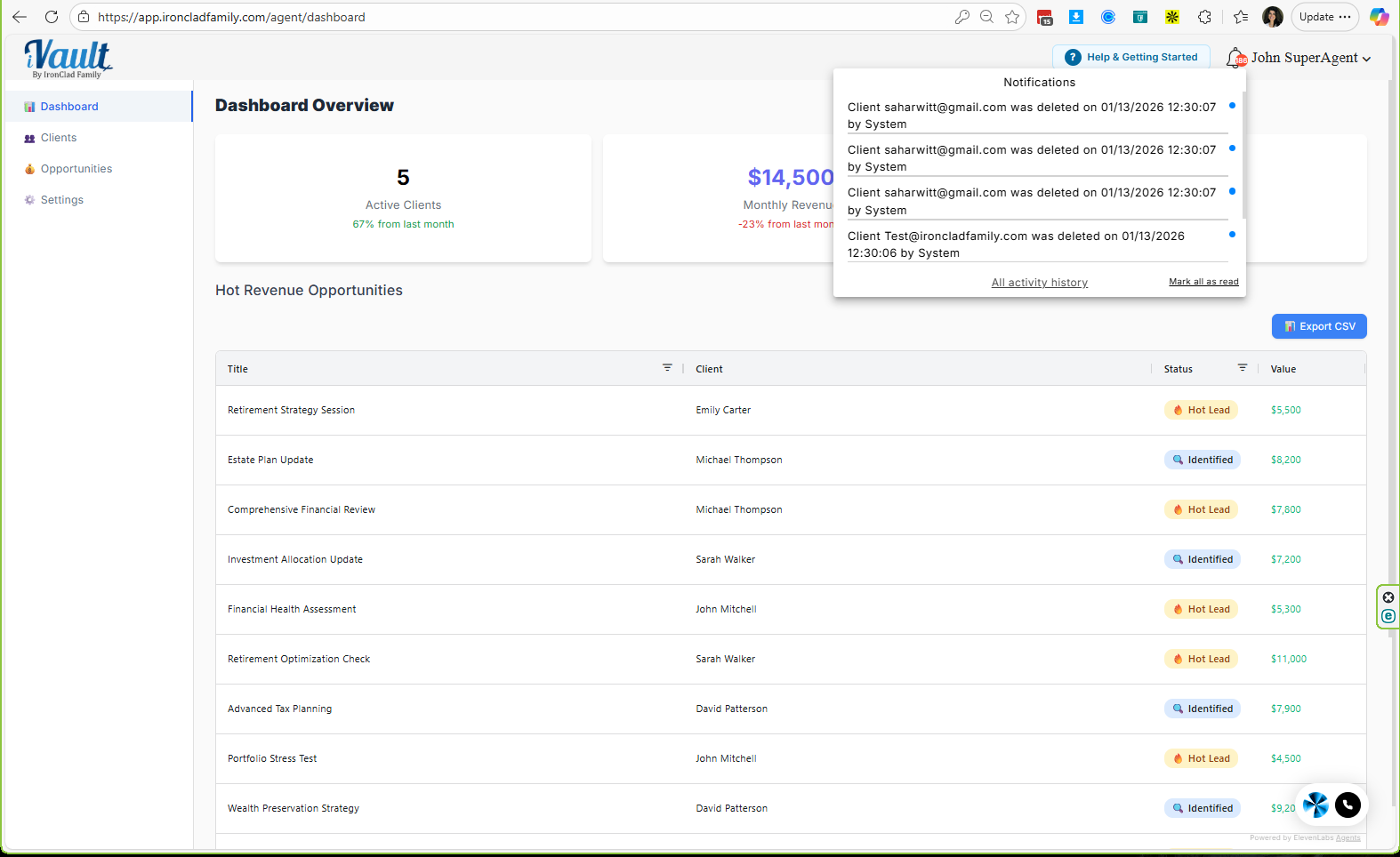
iVaultX maintains activity signals around vault actions so you can establish a timeline of what was done and by whom.
- Log of key actions — records created, edited, or removed; documents attached, replaced, or detached; recipient and delivery changes.
- Timestamped entries tied to specific users to support traceability.
- Change visibility for important planning records — wills, trusts, insurance policies, and other critical documents.
Advisor tip: Keep the audit trail clean by editing existing records rather than creating duplicates. When a policy renews or a will is re-executed, open the record, use Edit details, and Replace the attached document. One record per real-world instrument, with a dated history of changes, reads far better under review than three near-identical records with no indication of which is current.
4) Client communication & documentation
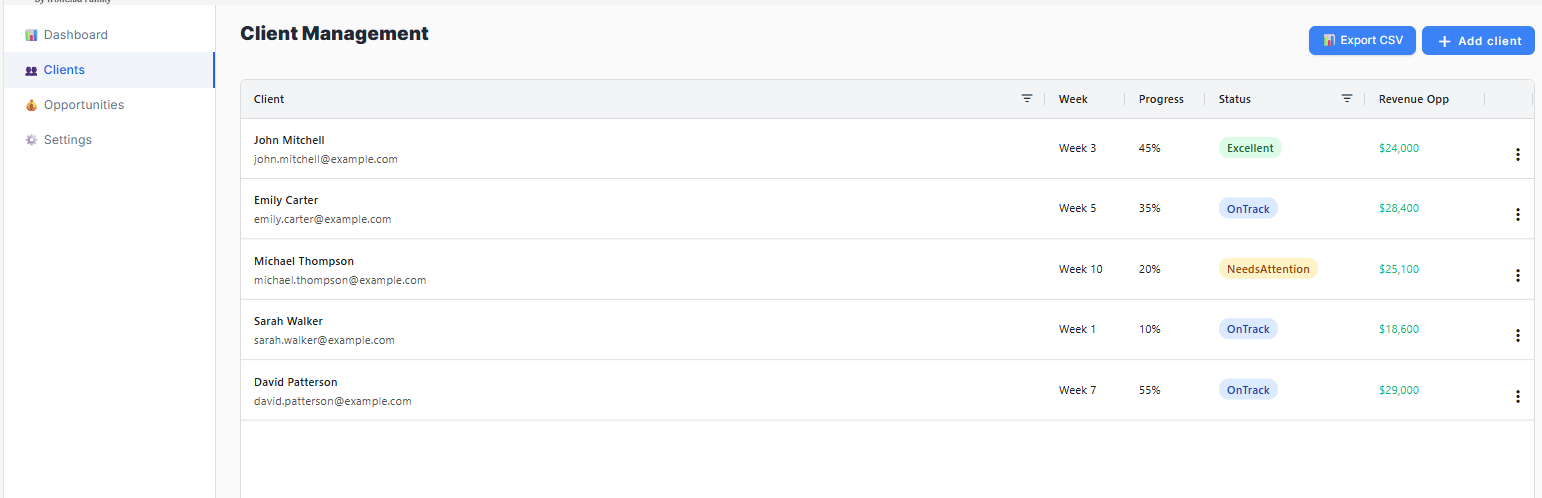
Supporting records for client planning work stay in one place — fewer scattered emails, missing attachments, and “where did we put that?” moments.
- Centralized storage for executed documents and supporting materials.
- Gap visibility so you can document what was missing and what was addressed during planning.
- Multi-generational clarity through structured records and recipient-based vault organization.
5) Digital assets and RUFADAA
The Revised Uniform Fiduciary Access to Digital Assets Act — adopted in nearly every state — governs when a fiduciary may access someone's digital property. Its core principle is that the client's own written instructions take precedence. Absent those instructions, the platform's terms of service govern, and most default to denying access.
Two features in the platform speak directly to this:
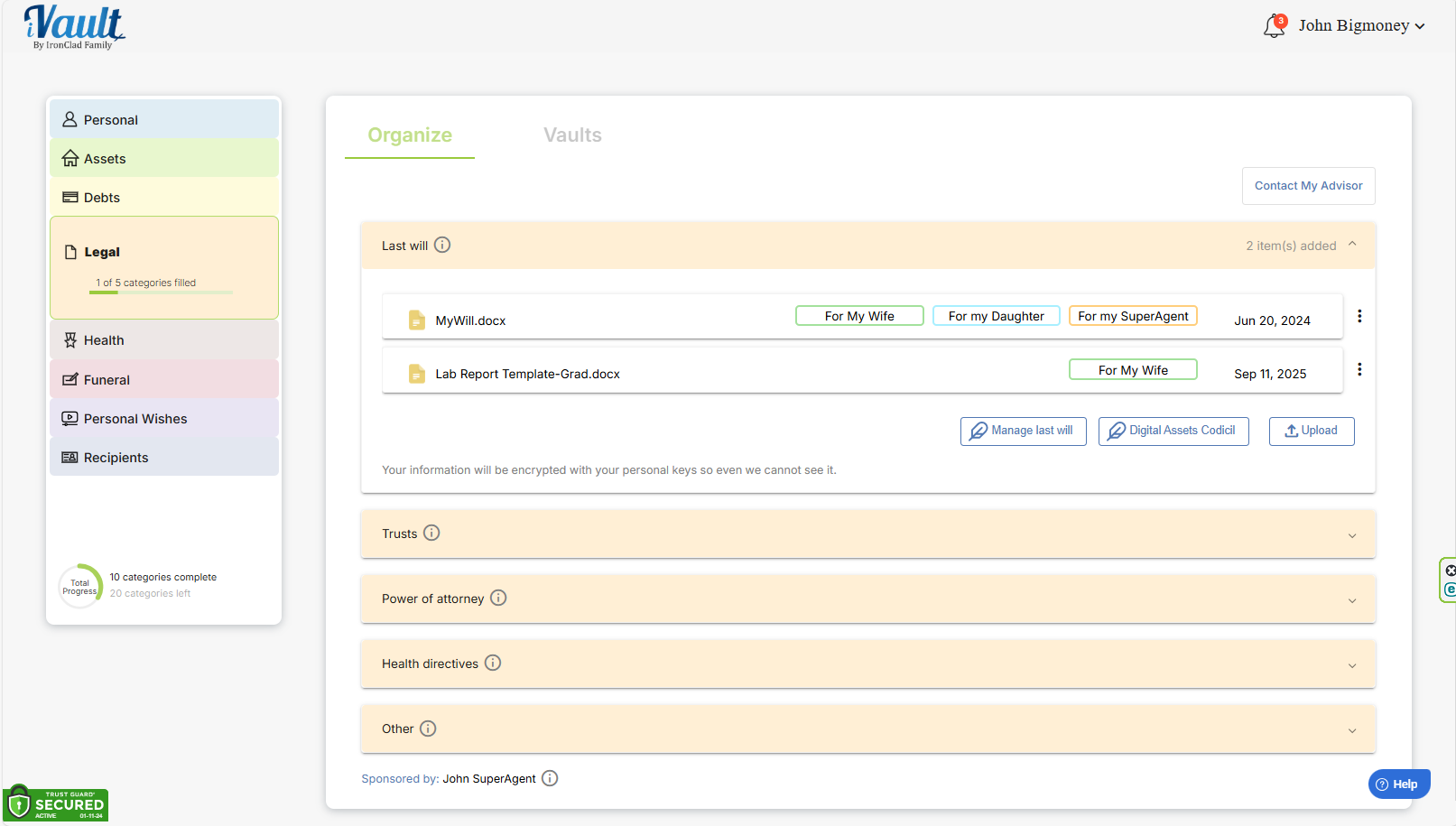
- The codicil wizard produces a dated document granting explicit digital-access rights, without requiring the client to have their will redrafted.
- Digital asset records — under Personal › Web, social media & devices and Assets › Crypto — capture what the client holds, where recovery information lives, and what they want done with each account.
Together these give you a documented answer to a question most estate files can't answer: what digital property exists, and who is authorized to reach it. Cryptocurrency is the sharpest case — there is no probate process and no customer service line, so an undocumented holding is permanently unrecoverable.
6) Firm-level standards
Consistency is a compliance advantage. iVaultX supports firms wanting predictable client organization and repeatable advisor workflows.
- Standardized record structure — the same fields, the same categories, regardless of which advisor sits with the client.
- Repeatable onboarding workflow for client readiness, including structured review.
- Optional branding and messaging controls to keep client communication consistent at the firm level.
Recommended compliance workflow
- Start with minimum viable completeness. Core estate, insurance, ID, and property records first.
- Document what's missing before you begin recommendations. Empty fields on a saved record are themselves a dated record of a known gap.
- Confirm records are assigned to vaults. A record in no vault is stored but undeliverable — the most common failure mode on the platform, and one a reviewer will spot.
- Update as decisions occur. Edit the existing record and replace the attachment rather than stacking versions.
- Review periodically. Confirm recipients, beneficiaries, and delivery settings remain aligned after major life events.
Common pitfalls (and how iVaultX helps)
- Missing supporting documents — centralized storage reduces reliance on email threads and desktops.
- Unclear timeline — activity signals support reconstruction of what happened when.
- Inconsistent client organization — standard record structure reduces supervision overhead.
- Outdated documents lingering — in-place editing with document replacement, plus a review cadence, reduces stale information risk.
- Records that never reach anyone — unassigned records are visibly flagged, so the gap is findable before it matters.
- Beneficiary designations conflicting with the will — captured as a field, so the conflict surfaces during planning rather than during administration.
Related Articles
- Managing Client Vaults (Advisor Guide)
- Create and Maintain a Codicil
- How to Add Documents and Records to Your Vault
iVaultX supports your firm's compliance program but does not replace it. Your firm remains responsible for determining when documents in the vault count as official books and records, how they should be archived, and what policies apply to supervision, retention, and client communication.
Was this article helpful?
That’s Great!
Thank you for your feedback
Sorry! We couldn't be helpful
Thank you for your feedback
Feedback sent
We appreciate your effort and will try to fix the article